 Paper Mew
A small grid, a different question.
A closer look at how ink pairs and portals change the way a line puzzle asks you to plan ahead.
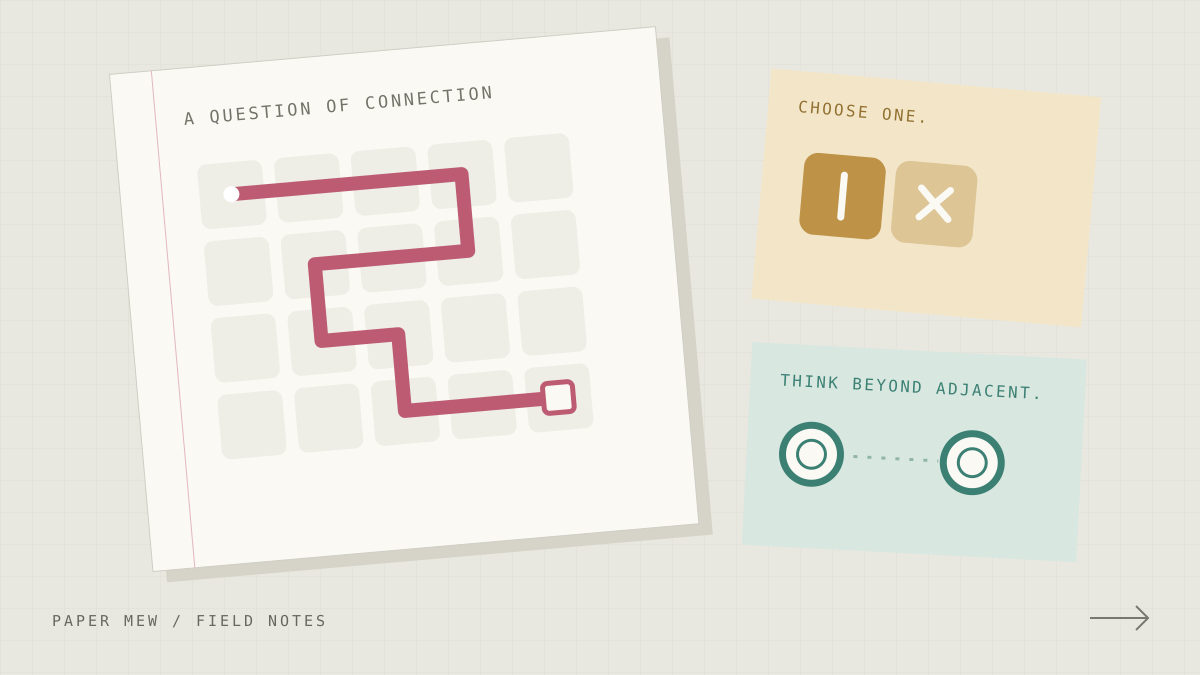
A line puzzle begins with a simple relationship: this square is next to that one. Fill Trail keeps that idea easy to read, then changes one part of it at a time. The result is three modes that share the same drawing gesture but ask different questions.
Fill: think about what remains
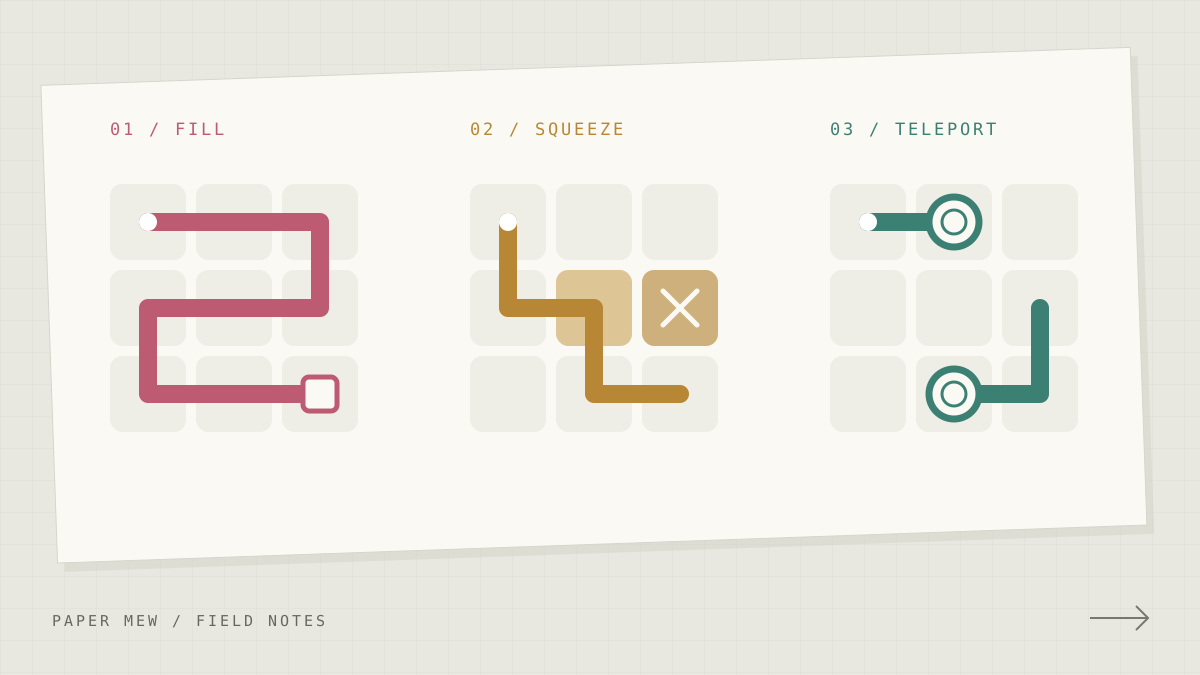
Drawing through an open square also changes the route that remains. A useful question is not only “Where can I go next?” but “What will still be reachable after I go there?” Keeping the finish until last gives that question a clear purpose.
Squeeze: a choice changes the board
An ink pair offers two neighboring squares, but the route uses only one. Entering one side closes the other. Choosing a square therefore also means deciding which connection to give up. Undo restores that choice, so another possibility can be explored.
The mechanism makes a small part of the board do more work: it is both a place to draw and a decision about the shape of the remaining path.
Teleport: nearby is not the only connection
A paired portal changes where the trail continues. The entrance and exit may be separated on screen, but the route continues from the matching exit. The jump is not an ordinary line drawn across the squares between them.
This asks you to consider the board as a set of connections as well as a visible shape. A distant corner may be the next place to visit.
Keep the result of a move readable
- The route shows where you have been.
- A closed ink square makes the consequence of a choice visible.
- Paired portal rings identify where a jump continues.
These mechanics give each mode its own question while keeping the basic action familiar: draw, look at what changed, and decide where to go next.